

Top Agile Trends for 2026: AI, Outcome Metrics and Enterprise Adoption
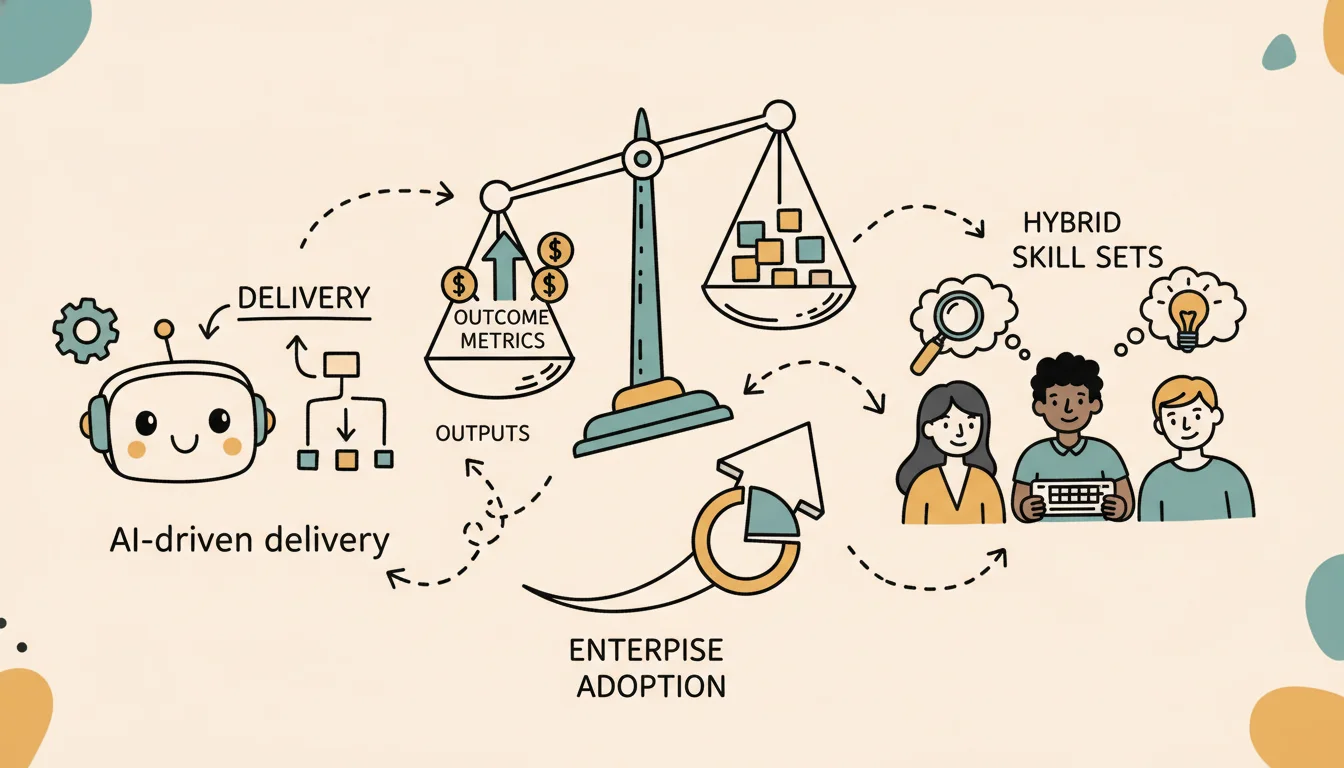
Agile in 2026 is undergoing one of its most significant transformations since the original Manifesto was written. According to eSparkBiz, enterprise Agile transformation services are projected to grow at a 19.50% CAGR by the end of 2026, signaling that adoption is accelerating far beyond small product teams. At the same time, the nature of Agile work is shifting — from lightweight team rituals toward AI-enabled delivery, measurable business outcomes, and complex enterprise governance. For product leaders, Scrum Masters, and transformation managers, understanding these changes is no longer optional; it is a prerequisite for staying competitive.
Many organizations still measure Agile success by story points completed, sprint velocity, or the number of ceremonies held per quarter. These output-focused metrics made sense when Agile was primarily a team-level methodology, but they fall short in environments where AI is reshaping delivery speed, distributed teams span multiple time zones, and regulatory bodies demand auditability. The gap between how Agile is practiced and what enterprises actually need has never been wider — and this article addresses that gap directly.
In the sections that follow, you will learn how AI is becoming embedded in Agile delivery pipelines, why outcome metrics are replacing output-only tracking, how enterprise adoption is expanding under tighter governance constraints, and what hybrid skill sets Agile professionals need in 2026. Each section includes practical advice, real-world case patterns, and specific data points so you can apply these insights immediately in your organization.
AI Is Becoming Part of the Agile Delivery Engine
The most visible Agile trend for 2026 is the deep integration of AI into the software development lifecycle. AI coding assistants, automated testing platforms, and intelligent DevOps pipelines are no longer experimental add-ons — they are increasingly embedded in daily delivery workflows. GitHub data cited by 10Pearls indicates that developers using AI coding assistants complete certain tasks up to 55% faster, which is one of the clearest quantitative signals that AI has moved from curiosity to productivity multiplier. For Agile teams, this means sprint capacity calculations, definition-of-done criteria, and team agreements all need to be revisited with AI-assisted work in mind.
Beyond individual coding speed, AI is being applied at the process level to improve forecasting and risk detection. AI-powered systems can now predict sprint velocity based on historical delivery data, flag recurring impediment patterns before they become blockers, and recommend backlog prioritization based on business value signals. A distributed product team, for example, might use AI assistants to shorten cycle time for routine implementation tasks while redirecting Scrum Master attention toward dependency management and cross-team coordination — work that requires human judgment and relationship skills that AI cannot replicate.
The practical implication for Agile professionals is that AI adoption must be treated as a process change, not just a tooling upgrade. Teams need new working agreements that define when AI-generated output requires human review, particularly for architecture decisions, security-sensitive logic, and customer-facing features in regulated industries. Organizations that introduce AI tools without updating their quality controls and accountability structures often see short-term speed gains followed by longer-term quality debt — a pattern that undermines the very agility they were trying to improve.
- Start AI adoption with low-risk, high-volume tasks: test generation, documentation drafts, and repetitive code reviews
- Require human review for architecture, security decisions, and customer-facing logic in regulated industries
- Update team working agreements and quality controls before scaling AI tooling across squads
- Use AI sprint forecasting as an input to planning, not as a replacement for team judgment
- Track AI-assisted vs. human-authored work to understand where quality risks are concentrated
Outcome Metrics Are Replacing Output-Only Tracking
A second major trend reshaping Agile in 2026 is the shift from measuring activity to measuring outcomes. In practice, this means Agile teams are being evaluated less by story points completed or sprint burndown charts alone, and more by whether their work creates measurable business value. The reason is straightforward: in a complex enterprise environment, velocity can rise consistently while customer satisfaction, revenue impact, or product adoption remain flat. Executives and portfolio managers are increasingly unwilling to fund delivery capacity that cannot demonstrate a clear link to business results.
This shift is reinforced by broader enterprise trends in AI-enabled decision-making. PwC's 2026 Digital Trends in Operations Survey found that AI-enabled tools are used in planning and forecasting by 66% of respondents and in sourcing and procurement by 64%. While that survey covers enterprise functions beyond Agile teams, it signals the same underlying expectation: decisions should be data-driven, measurable, and tied to operational outcomes. Agile teams that still report primarily on effort and activity are increasingly out of step with how enterprise leadership evaluates performance.
A concrete example illustrates the difference well. An internal platform team that stops reporting only on features shipped and instead tracks onboarding completion time, support ticket reduction, and user satisfaction scores will often discover that some high-velocity sprints delivered little actual value — and some lower-velocity periods produced significant business improvement. That insight changes how the team prioritizes work, how product managers justify roadmap decisions, and how senior stakeholders allocate investment across competing initiatives.
Enterprise Adoption Is Expanding Under Tighter Governance Constraints
Agile is increasingly being adopted at enterprise scale, but in 2026 large organizations are also operating under tighter constraints around compliance, cybersecurity, and data governance. The 'move fast and adapt' principle that characterized early Agile adoption must now coexist with auditability requirements, clear decision rights, and regulatory checkpoints. This is not a contradiction of Agile values — it is a maturation of how Agile is designed and implemented in complex organizational environments. Enterprises that treat governance as external to Agile will struggle; those that embed it into delivery workflows will find it becomes a competitive advantage.
10Pearls notes that Agile in 2026 must support AI-driven engineering, distributed teams, regulatory compliance, and complex digital platforms simultaneously. This reflects a broader structural shift: enterprises are no longer adopting Agile only to improve software delivery teams, but to coordinate across product, operations, data, security, and legal functions. A financial services company scaling Agile across digital channels, for instance, can maintain Scrum at the team level while adding lightweight governance checkpoints for risk assessment, privacy review, and model transparency wherever AI-generated recommendations are involved in customer decisions.
The practical implication is that enterprise Agile frameworks must support multiple teams without losing accountability or creating governance theater — compliance steps that exist on paper but are bypassed in practice. Definition of done in 2026 enterprise environments increasingly includes security checks, compliance gates, and data-quality validation as standard criteria, not optional additions. Agile coaches and transformation managers who can design operating models that preserve team autonomy while satisfying enterprise oversight requirements are among the most valuable professionals in the market right now.
Distributed Teams and Async-First Agile Practices
Distributed work is no longer a temporary adaptation — it is a permanent feature of enterprise Agile in 2026. Teams spanning multiple time zones, countries, and organizational structures are the norm rather than the exception for large digital programs. This creates specific challenges for Agile ceremonies that were originally designed for co-located teams: daily stand-ups, sprint reviews, and retrospectives all need to be redesigned for asynchronous-first environments without losing the collaborative intent behind them. Organizations that simply move their in-person ceremonies to video calls without rethinking the format often see engagement drop and decision quality decline.
Async-first Agile practices in 2026 rely heavily on structured written communication, shared digital artifacts, and AI-assisted summarization tools that help distributed teams stay aligned without requiring everyone to be online simultaneously. Sprint planning, for example, can be split into an async preparation phase — where team members review and annotate the backlog independently — followed by a shorter synchronous session focused on decisions and dependencies rather than discovery. This approach reduces meeting fatigue, improves preparation quality, and makes it easier to include team members in time zones that would otherwise be excluded from core planning conversations.
The governance dimension of distributed Agile is equally important. When teams are spread across jurisdictions, data residency rules, employment regulations, and security policies may differ significantly between locations. Agile operating models in 2026 need to account for these differences explicitly, rather than assuming that a single set of team agreements will work uniformly across a global delivery organization. Transformation managers who build geographic and regulatory awareness into their Agile design work will avoid the costly rework that comes from discovering compliance gaps after a framework has already been deployed at scale.
The Hybrid Skill Set: Delivery, Data, and AI Fluency
The fourth major trend concerns capability development. Agile professionals in 2026 need more than strong facilitation skills and process knowledge — they need enough AI literacy and data fluency to work effectively in AI-enabled delivery environments. This does not mean every Scrum Master must become a data scientist or machine learning engineer. It does mean they should understand how AI tools affect estimation accuracy, quality assurance, backlog prioritization, and team dynamics, so they can guide teams through the changes rather than being caught off guard by them.
For product leaders and transformation managers, the hybrid skill set also includes outcome-based reporting and product experimentation design. If AI systems are predicting sprint velocity and recommending which backlog items to prioritize, then Agile leaders must know when to trust the model, when to question its assumptions, and how to explain AI-driven recommendations to business stakeholders who may be skeptical or unfamiliar with how these tools work. That combination of technical awareness and stakeholder communication is increasingly what separates effective Agile leaders from those who are simply running ceremonies.
A strong practical example is a Scrum Master who uses AI-generated insights to identify recurring blockers — such as consistent dependency delays from a shared infrastructure team — and then works with engineering managers and product owners to address the root cause rather than just noting the impediment in a retrospective. That kind of strategic intervention, informed by data and enabled by AI tooling, represents the evolution of the Scrum Master role from process facilitator to organizational problem-solver. It is also the kind of contribution that earns Agile professionals a seat at enterprise decision-making tables.
Agile Portfolio Management and Strategic Alignment
As Agile scales across enterprises, portfolio management is emerging as one of the most critical and most underdeveloped capabilities in the Agile ecosystem. Traditional project portfolio management focused on resource allocation, milestone tracking, and budget control — all of which are necessary but insufficient for organizations running dozens of concurrent Agile product teams. In 2026, effective Agile portfolio management means connecting team-level delivery to strategic business objectives, making investment decisions based on outcome data rather than project plans, and creating feedback loops that allow leadership to reallocate resources quickly when market conditions change.
The integration of AI into portfolio management is accelerating this shift. AI-enabled portfolio tools can now aggregate delivery data across teams, identify patterns in initiative performance, and surface early warning signals when a product stream is trending toward low business impact despite high team activity. For enterprise PMO teams, this creates an opportunity to move from being a reporting and compliance function to being a genuine strategic partner — one that helps senior leaders understand where Agile investment is generating returns and where it needs to be redirected.
The practical challenge is that most organizations have not yet built the data infrastructure or the governance processes needed to make Agile portfolio management work at enterprise scale. Teams use different tools, define metrics differently, and report progress in formats that are difficult to aggregate meaningfully. Transformation managers who prioritize standardizing outcome reporting and building shared data pipelines across Agile teams will create the foundation that makes strategic portfolio management possible — and that foundation is increasingly what enterprise executives are asking for when they talk about 'scaling Agile.'
Frequently Asked Questions
Часто задаваемые вопросы
How is AI specifically changing Agile sprint planning in 2026?
What outcome metrics should Agile teams track instead of story points?
How can enterprises maintain Agile flexibility while meeting compliance requirements?
What skills do Agile professionals need to develop for 2026?
Is Agile still relevant for large enterprises in 2026, or is it being replaced by other frameworks?
How should distributed Agile teams handle ceremonies across multiple time zones?
What are the most common mistakes organizations make when scaling Agile in 2026?
How does Agile portfolio management differ from traditional project portfolio management?
Conclusion
The top Agile trends for 2026 are not isolated developments — they are interconnected signals of a structural shift in how organizations deliver value. AI is accelerating delivery speed and improving forecasting quality. Outcome metrics are replacing output tracking as the primary measure of Agile success. Enterprise adoption is expanding under tighter governance constraints that require Agile frameworks to be both flexible and auditable. Distributed teams are driving the adoption of async-first practices. And the skill sets required of Agile professionals are evolving to include AI literacy, data fluency, and strategic stakeholder management alongside traditional facilitation expertise.
For product leaders, Scrum Masters, transformation managers, and enterprise PMO teams, the practical response is clear: start by auditing how your organization currently measures Agile success, identify where AI tooling can reduce friction in your delivery pipeline, and design governance checkpoints that are embedded in your workflow rather than layered on top of it. Organizations that make these changes will deliver faster, demonstrate value more clearly to executive stakeholders, and build the enterprise-scale Agile capability that 2026 demands. Those that do not risk falling behind competitors who have already made the shift.
- Integrate AI into delivery workflows starting with low-risk, high-volume tasks and update team working agreements to govern AI-assisted output quality
- Replace output-only tracking with outcome metrics by defining one primary business outcome per initiative and reviewing it jointly with product, engineering, and business stakeholders
- Embed governance checkpoints — security, compliance, data quality — directly into the definition of done rather than treating them as external approval gates
- Redesign Agile ceremonies for async-first distributed teams, using synchronous time exclusively for decisions and dependency resolution
- Invest in hybrid skill development for Agile professionals: AI literacy, outcome-based reporting, and cross-functional stakeholder alignment are the capabilities that drive enterprise transformation in 2026
Your evaluations help make the blog even better and more informative.