

CRM Evolves Into a Full Customer Experience Platform with Autonomous AI Agents
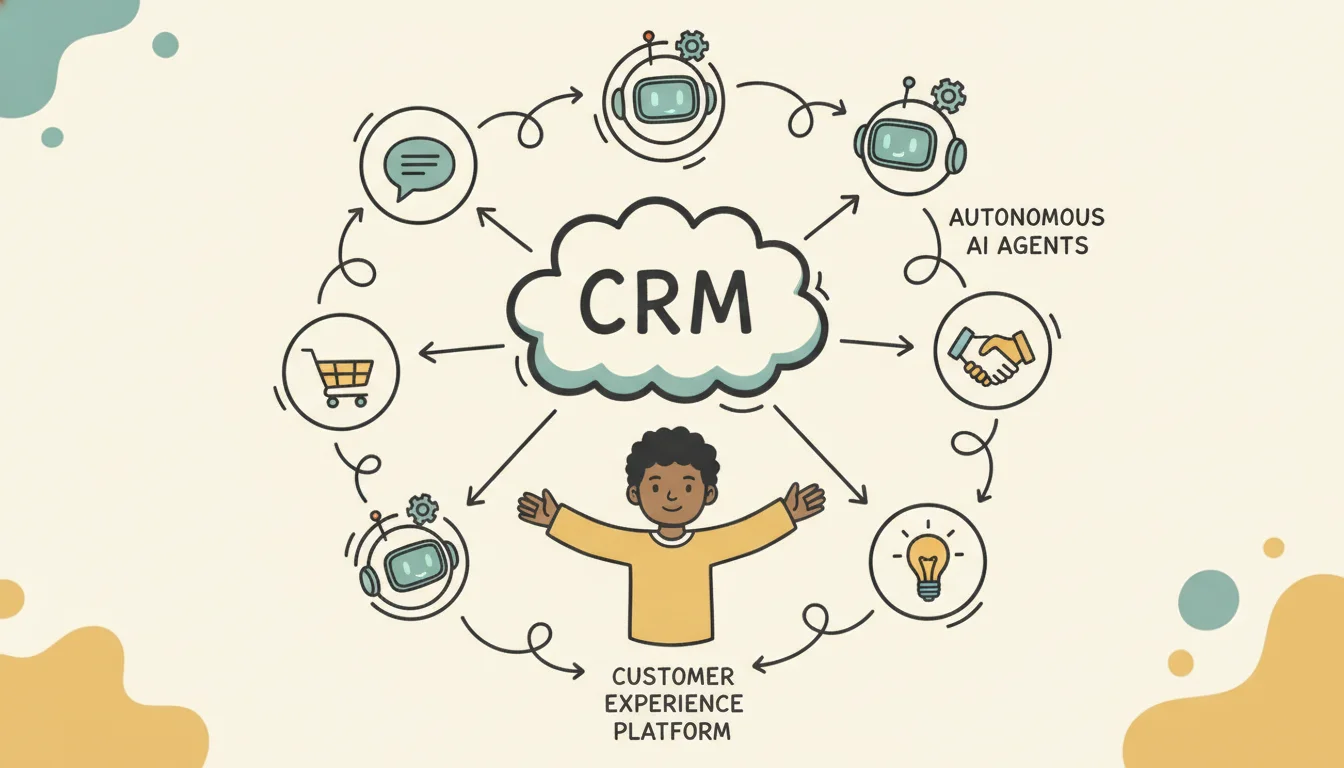
For more than two decades, CRM systems served a relatively straightforward purpose: store customer data, log interactions, and help sales and support teams stay organized. Today, that era is coming to a definitive end. According to industry analysts, the global CRM market is expected to surpass $157 billion by 2030, and the primary driver of this growth is no longer data storage — it is intelligent automation. Autonomous AI agents are rewriting the rules of customer engagement, transforming CRM from a passive database into a proactive, always-on customer experience engine.
The challenge facing most organizations today is a familiar one: customers demand instant, personalized, and consistent experiences across every channel, while businesses are under pressure to reduce operational costs and improve efficiency simultaneously. Traditional CRM platforms, built on rigid workflows and manual data entry, are simply not equipped to meet these expectations at scale. The gap between what customers expect and what legacy CRM systems can deliver has never been wider — and autonomous AI agents are emerging as the critical bridge.
In this article, you will learn exactly how CRM is evolving into a full customer experience (CX) platform, what autonomous AI agents can do across sales, marketing, and service functions, how leading vendors like Microsoft are already deploying agentic CRM in production environments, and what practical steps your organization can take to start leveraging this transformation. Whether you are a CRM administrator, a digital transformation leader, or a CX strategist, this guide will give you a concrete and actionable understanding of where the industry is heading and how to stay ahead.
From System of Record to System of Action: What Is Driving the CRM Shift
The fundamental shift in CRM is driven by two converging forces: rising customer expectations and the maturation of generative and agentic AI technologies. Customers today expect seamless, omnichannel experiences where context is preserved across every interaction — whether they reach out via chat, voice, email, or social media. They do not distinguish between departments or systems; they simply expect the company to know who they are and what they need. This expectation places enormous pressure on organizations to break down internal silos and unify their customer engagement infrastructure around a single, intelligent platform.
At the same time, advances in large language models (LLMs), natural language processing, and agentic AI architectures have made it possible for software to do far more than answer scripted questions. Modern AI agents can interpret customer intent across voice and digital channels, maintain context across multi-turn conversations, securely access enterprise data, execute complex workflows, and escalate to human agents with full context when needed. These capabilities transform CRM from a tool that helps humans do their jobs into a platform where AI agents actively complete tasks — qualifying leads, resolving cases, drafting communications, and generating knowledge — with minimal human intervention.
Microsoft's approach to this transformation is particularly instructive. The company already offers 11 AI agents and copilots across Dynamics 365 Sales and Customer Service, including a Sales Qualification Agent, a Case Management Agent, and a Knowledge Management Agent. These are not experimental features — they are production-ready tools designed to operate autonomously in the background, delivering completed outputs to human specialists rather than simply assisting them in real time. This signals a broader industry consensus: CRM is no longer a single product but a platform of interacting AI agents that span the entire customer lifecycle.
How Autonomous AI Agents Work Inside a Modern CRM Platform
Unlike traditional CRM automation, which relies on hard-coded rules and static decision trees, autonomous AI agents are built on machine learning and natural language understanding. They interpret intent rather than match keywords, adapt their behavior based on historical interaction data, and continuously improve their accuracy over time. An AI agent embedded in a CRM platform does not simply respond to a trigger — it reasons about the best course of action, accesses relevant data from connected systems, executes a sequence of steps, and delivers a result. This makes them fundamentally different from the chatbots and workflow automation tools that preceded them.
In a sales context, a Sales Qualification Agent can autonomously research inbound leads from trade shows or web forms, compare them against ideal customer profiles and competitive intelligence, score them based on fit and intent signals, and draft personalized follow-up emails — all before a human sales representative ever opens the CRM. In a service context, a Customer Intent Agent can analyze incoming customer conversations 24 hours a day, 7 days a week, identify the underlying intent, and autonomously resolve a significant share of routine inquiries without any human involvement. These are not theoretical capabilities; they are being deployed by enterprise customers today.
What makes agentic CRM particularly powerful is the concept of a learning loop. Every interaction that an AI agent handles — whether it resolves the issue autonomously or escalates to a human — generates data that feeds back into the system. A Knowledge Management Agent, for example, mines completed cases and conversations to identify new insights, gaps in the knowledge base, and emerging customer issues. These insights are then used to improve self-service experiences, train other agents, and update human-assist tools. Over time, the system becomes progressively smarter, more accurate, and more capable of handling complex scenarios without human intervention.
Real-World Examples of CRM Becoming a Full CX Platform
The most compelling evidence for this transformation comes from real-world deployments. In Microsoft's Dynamics 365 ecosystem, the Sales Qualification Agent has been used to automate the entire process of managing trade show leads — from initial assignment and online research to competitive comparison and personalized email drafting. Sales reps receive pre-qualified, context-rich leads with ready-to-send communications, rather than spending hours on manual research and data entry. Early adopters report significant reductions in time-to-first-contact and measurable improvements in lead conversion rates, demonstrating that agentic CRM has a direct impact on revenue outcomes.
On the service side, a documented Microsoft customer example illustrates how three AI agents can work together to create an autonomous contact center. The Customer Intent Agent handles the initial interpretation and resolution of incoming inquiries. When a case requires ongoing tracking, the Case Management Agent takes over, managing the case through to closure and updating the CRM system based on follow-up conversations and actions. Meanwhile, the Knowledge Management Agent continuously mines these interactions to harvest new knowledge and feed it back into both self-service and assisted-service channels. Together, these three agents create a self-improving, autonomous service operation that scales without proportional headcount increases.
Vendors beyond Microsoft are also moving in this direction. AI-native CX platforms from companies like NICE, Salesforce, and ServiceNow are repositioning themselves not as contact center tools or CRM databases, but as AI agent orchestration layers that span channels, touchpoints, and business functions. These platforms describe their AI agents as digital service representatives — capable of managing interactions from start to finish, interpreting intent across voice and digital channels, accessing customer history, executing actions such as account updates or order changes, and escalating with full context when human judgment is required. This is a practical illustration of CRM evolving into a CX execution platform where outcomes — resolved issues, completed orders, retained customers — matter more than records or tickets.
Business Benefits: Why Agentic CRM Delivers Both Cost Savings and Revenue Growth
One of the most compelling aspects of the CRM-to-CX-platform evolution is that it simultaneously attacks cost and revenue — two objectives that are typically in tension. On the cost side, AI agents offload repetitive, time-consuming tasks such as data entry, lead research, case classification, knowledge article creation, and basic troubleshooting. In contact centers, autonomous agents can resolve a substantial share of routine interactions — estimates from early deployments suggest 30% to 50% of tier-one inquiries can be handled without human involvement — freeing human agents to focus on complex, high-value cases. This raises service levels and shortens resolution times without requiring proportional increases in headcount.
On the revenue side, AI agents embedded in CRM create new opportunities for proactive, personalized engagement at scale. Predictive analytics capabilities within agentic CRM platforms can forecast customer behavior, identify churn risk signals, predict buying patterns, and surface next-best-action recommendations in real time. Sales-focused agents can qualify leads, recommend optimal outreach timing, and personalize email content based on individual customer profiles and behavioral signals — improving conversion rates and accelerating pipeline velocity. For businesses in sectors where customer lifetime value and retention are critical, such as B2B SaaS, financial services, telecom, and e-commerce, these capabilities translate directly into measurable revenue growth.
- AI agents provide 24/7 customer support, reducing response times and increasing satisfaction scores
- Autonomous lead qualification improves sales pipeline quality and accelerates conversion rates
- Predictive analytics enable proactive retention interventions before churn signals escalate
- Knowledge Management Agents continuously improve self-service accuracy, reducing repeat contacts
- Copilot features save individual users hours of manual work per week through summarization and drafting
Practical Steps to Start Building an Agentic CRM Strategy
The most common mistake organizations make when approaching agentic CRM is trying to deploy too many AI agents simultaneously across too many use cases. This leads to fragmented implementations, inconsistent data quality, and poor adoption among frontline users. A more effective approach is to start with a single, high-impact use case that has clear success metrics and a well-defined scope. For sales teams, this might mean deploying a lead qualification agent for a specific product line or geographic market. For service teams, it might mean implementing intent detection and automated routing for the top five most common inquiry types. Define your success metrics — such as time-to-first-response, conversion rate, or handle time — before you begin, and measure rigorously against them.
Data quality is the foundation upon which every AI agent depends. Agents are only as accurate and useful as the data they consume, and CRM systems that have accumulated years of inconsistent records, duplicate entries, and disconnected systems will produce unreliable agent outputs. Before deploying AI agents at scale, organizations should invest in data governance: establishing consistent customer identity resolution, cleaning and standardizing key fields, and connecting CRM with core enterprise systems such as billing, product usage, support history, and marketing engagement data. This 360-degree customer view is what enables agents to make contextually relevant decisions rather than generic responses.
Equally important is the design of hybrid workflows that allow AI agents and human specialists to collaborate effectively. The most mature agentic CRM deployments use a layered approach: agents handle routine tasks end-to-end, but escalate to humans with full context for exceptions, complex scenarios, or sensitive interactions. AI drafts emails, summaries, and case updates, but humans review and approve outputs in high-stakes situations. Organizations should also establish monitoring and oversight infrastructure — dashboards to track agent performance, exception queues for edge cases, and feedback loops that allow human specialists to flag incorrect agent behavior and continuously improve model accuracy. Several platforms are beginning to offer dedicated agent management layers, such as Agent Feed and Agent 365, specifically designed to configure, monitor, and orchestrate fleets of agents across the CX stack.
Common Mistakes Organizations Make When Adopting Agentic CRM
One of the most significant pitfalls in agentic CRM adoption is treating AI agents as a technology project rather than an organizational transformation. Companies that deploy AI agents without redesigning the workflows, roles, and KPIs around them often find that agents create confusion rather than clarity — sales reps unsure whether to trust AI-generated lead scores, service agents uncertain about when to override automated case resolutions, and managers lacking the visibility to evaluate agent performance. Successful agentic CRM requires deliberate change management: clear communication about what agents will and will not do, training for frontline users on how to prompt, review, and correct AI outputs, and updated performance metrics that measure team-plus-agent outcomes rather than individual human productivity alone.
Another common mistake is neglecting the knowledge base that agents depend on. AI agents grounded in an organization's own documented procedures, product information, and resolution histories perform dramatically better than agents relying solely on general-purpose language model knowledge. Organizations that skip the step of building and maintaining a structured, accurate internal knowledge base will find their agents producing hallucinated or inaccurate responses — eroding customer trust and creating additional work for human specialists. Regular audits of agent outputs, combined with a Knowledge Management Agent that continuously harvests new insights from resolved interactions, are essential for maintaining accuracy over time.
The Future of CRM: Platforms, Ecosystems, and the Agentic Mindset
Looking ahead, the trajectory of CRM evolution points toward increasingly interconnected ecosystems of specialized AI agents, each optimized for a specific function but capable of collaborating seamlessly across the customer journey. Rather than a single monolithic CRM application, organizations will operate a coordinated fleet of agents — some focused on sales qualification, others on service resolution, others on marketing personalization, and others on retention and loyalty — all sharing a unified customer data layer and governed by a central orchestration platform. This architectural shift has profound implications for how CRM vendors compete, how IT teams architect their technology stacks, and how business leaders think about customer experience strategy.
The organizations that will lead in customer experience over the next decade are those that adopt what might be called an agentic mindset: treating AI agents as digital teammates rather than tools, redesigning processes around human-agent collaboration rather than human-only workflows, and investing continuously in the data quality, knowledge management, and skills development that make agents effective. This is not a one-time technology deployment — it is an ongoing operating model transformation that requires sustained leadership commitment, cross-functional alignment, and a willingness to learn from both successes and failures as the technology continues to evolve rapidly.
For CRM and CX professionals, the message is clear: the window for competitive differentiation through agentic CRM is open now, but it will not remain open indefinitely. As AI agent capabilities become commoditized across major platforms, the advantage will shift from who has the technology to who has built the best data foundations, the most effective human-agent workflows, and the deepest organizational capability to learn and adapt. The time to move beyond proof-of-concept chatbots and start building a cohesive AI agent strategy is not next year — it is today.
Frequently Asked Questions
What is the difference between a traditional CRM and an agentic CRM platform?
How many AI agents does Microsoft currently offer in Dynamics 365?
What percentage of customer service inquiries can autonomous AI agents resolve without human involvement?
How should organizations prepare their CRM data before deploying autonomous AI agents?
What are the most effective use cases for AI agents in a sales CRM context?
How do organizations avoid the most common mistakes when implementing agentic CRM?
Will autonomous AI agents replace human CRM and customer service professionals?
What metrics should organizations track to measure the success of agentic CRM deployments?
Conclusion: Building Your AI-Driven Customer Experience Strategy
The transformation of CRM from a system of record into a full customer experience platform powered by autonomous AI agents is not a distant future scenario — it is happening now, in production environments, at enterprise scale. Microsoft's 11 AI agents across Dynamics 365, the emergence of autonomous contact center architectures, and the repositioning of major CX vendors as AI agent orchestration platforms all point to the same conclusion: the CRM category as it existed for the past two decades is being fundamentally redefined. Organizations that recognize this shift early and begin building the data foundations, workflows, and skills required to leverage agentic CRM will establish a durable competitive advantage in customer experience and operational efficiency.
The path forward requires more than technology investment — it requires a genuine shift in how organizations think about customer engagement, team design, and performance measurement. Start with a focused use case, invest in data quality, design human-agent collaboration workflows deliberately, and build the organizational capability to learn and adapt as the technology evolves. The organizations that treat this as a strategic transformation rather than a software upgrade will be the ones that define what excellent customer experience looks like in the age of autonomous AI.
- CRM is evolving from a passive system of record into an active system of action, where autonomous AI agents complete tasks across sales, service, and marketing without constant human initiation.
- Leading vendors including Microsoft already offer production-ready AI agent ecosystems — including Sales Qualification, Case Management, and Knowledge Management agents — that work together to create self-improving CX platforms.
- Agentic CRM simultaneously reduces operational costs and drives revenue growth by automating routine tasks, enabling proactive personalization, and improving lead qualification and retention outcomes.
- Successful adoption requires strong data foundations, deliberate human-agent workflow design, and organizational change management — not just technology deployment.
- Organizations that adopt an agentic mindset now — treating AI as digital teammates and investing in the skills and processes to work alongside them — will set the competitive standard for customer experience in the years ahead.
Your evaluations help make the blog even better and more informative.