

AI-Driven Sales Automation and Hyper-Personalization in B2B
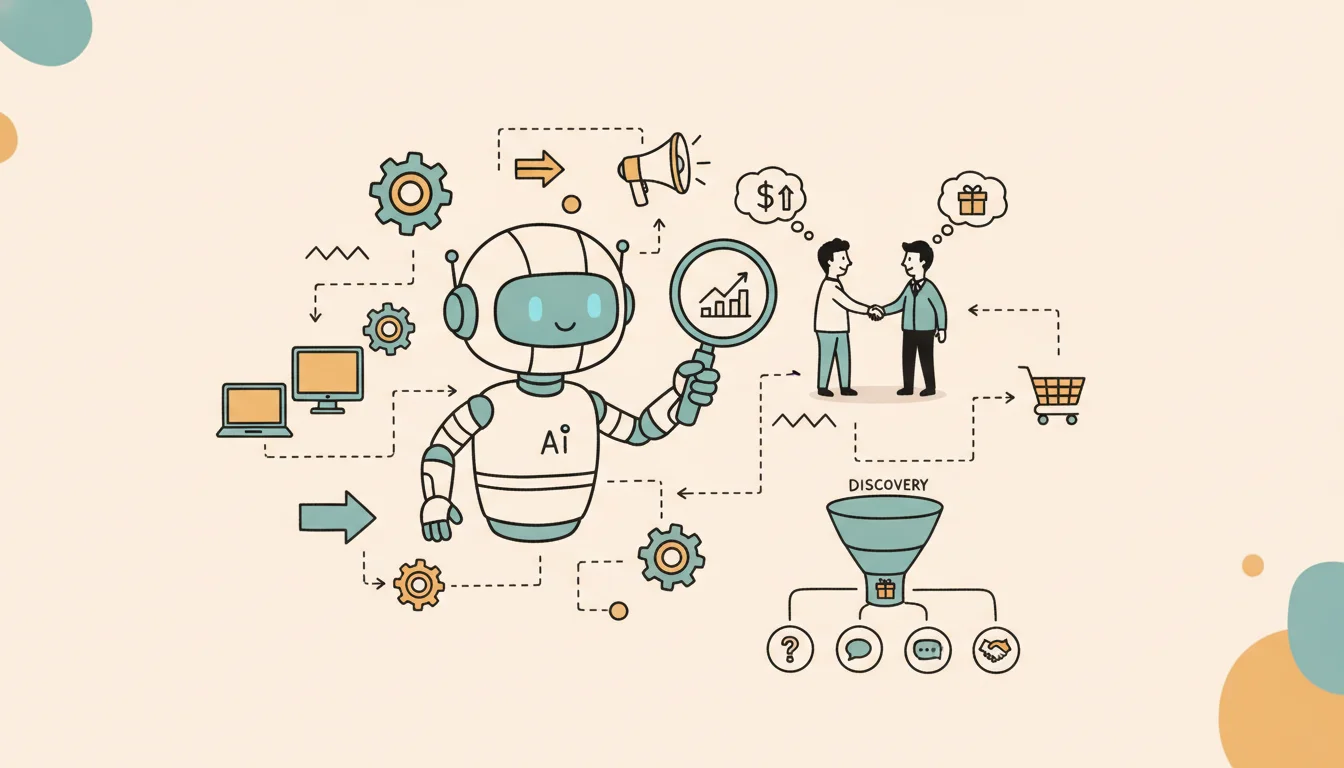
B2B sales is undergoing a fundamental transformation. As of 2024, 43% of sales professionals already use AI in their daily workflows — a figure that jumped 9% in a single year. Gartner predicts that 75% of B2B sales organizations will incorporate AI by 2025, making intelligent automation not an experiment but a competitive necessity. Companies that have already implemented AI in sales report 6–10% revenue growth and up to 20% higher lead generation from AI-powered tools alone.
The core problem is that traditional B2B sales motions — generic outreach, manual pipeline management, and gut-feel forecasting — no longer match the expectations of modern buyers. Today's B2B buying groups typically include 6–10 stakeholders, each with different priorities, timelines, and information needs. Sales teams are overwhelmed with administrative tasks, spending less than 35% of their time actually selling. The result is slower deal velocity, missed opportunities, and poor buyer experiences.
This article provides a comprehensive, expert-level guide to AI-driven sales automation and hyper-personalization in B2B. You will learn how AI reshapes every stage of the sales funnel — from lead generation and qualification to pipeline forecasting and deal closing. You will also discover practical implementation strategies, real-world outcomes, common pitfalls to avoid, and the tools that leading B2B organizations are using today to gain a decisive edge.
Why AI-Driven Sales Automation Is a Strategic Imperative in B2B
The structural complexity of B2B buying journeys makes AI not just useful but essential. When a single deal involves multiple stakeholders across procurement, finance, IT, and the C-suite, no human sales team can efficiently track every digital signal, engagement pattern, and intent indicator in real time. AI systems process these signals continuously — monitoring website behavior, email engagement, content consumption, and third-party intent data — and translate them into actionable prioritization for sales reps. This allows teams to focus effort precisely where it matters most, rather than spreading attention equally across hundreds of accounts.
Efficiency pressure is another major driver. McKinsey research shows that AI can free up 20–25% of a salesperson's time by automating data entry, follow-up scheduling, meeting preparation, and CRM updates. For a 50-person sales team, that translates into the equivalent of 10–12 additional full-time selling hours per day — without hiring a single new rep. In an environment where sales headcount growth is constrained and quota attainment rates are declining industry-wide, this productivity multiplier is transformative.
Finally, forecasting accuracy has become a boardroom-level concern. Revenue leaders in B2B are under increasing pressure to deliver reliable pipeline visibility in volatile markets. AI-powered predictive analytics replace subjective rep-reported commit numbers with models trained on CRM history, engagement velocity, multi-threading depth, and deal stage duration. Organizations using AI forecasting report significantly fewer end-of-quarter surprises and better resource allocation across their go-to-market teams.
How AI Automates the B2B Sales Funnel From Top to Bottom
At the top of the funnel, AI-powered chatbots and virtual assistants engage website visitors in real time, qualify them based on firmographic and behavioral criteria, and route high-intent leads to the right sales rep within minutes. In the United States, 26% of B2B marketers using AI chatbots report a 10–20% increase in lead generation volume. AI-based predictive lead scoring goes further, ranking entire account lists by conversion likelihood using firmographic data, technographic signals, and third-party intent feeds. Companies adopting predictive scoring consistently achieve 15–20%+ year-over-year improvements in lead-to-opportunity conversion rates.
In the middle of the funnel, AI automates multi-step outreach sequences and personalizes every touchpoint. Tools like Outreach, Salesloft, and Apollo use engagement data to recommend optimal send times, channel mix, and message variations. AI drafts personalized emails and LinkedIn messages that reference the prospect's industry, role, recent company news, or product usage patterns — so outreach feels genuinely 1:1 even when executed at scale across thousands of contacts. Automated reminders and task triggers ensure that no lead goes cold due to human oversight or capacity constraints.
At the bottom of the funnel, AI conversation intelligence platforms like Gong and Chorus analyze every sales call using speech recognition and natural language processing. They surface key topics, flag risk indicators such as low executive engagement or stalled deal momentum, and provide real-time coaching suggestions during live calls. These systems also identify what top-performing reps do differently — the questions they ask, the objections they handle, the talk-to-listen ratios they maintain — and make those insights available for team-wide coaching and onboarding.
Hyper-Personalization: Moving Beyond Account-Based to Individual-Based Selling
Traditional account-based marketing (ABM) segments buyers by industry, company size, or vertical and delivers tailored messaging at the account level. AI-driven hyper-personalization goes several layers deeper, creating micro-segments based on individual behavior, content consumption history, technology stack, support interactions, and product usage data. Instead of one pitch per vertical, sales teams can deliver role-specific value propositions, stage-appropriate content, and contextually relevant ROI narratives — all generated and adapted dynamically by AI models. By 2025, Gartner expects 60% of B2B sales firms to use AI advisors for data-based next-best-action recommendations.
Next-best-action engines represent one of the most powerful applications of AI personalization in B2B. By processing data from CRM, marketing automation, product telemetry, and customer support systems, these engines recommend the optimal next offer, the best time and channel to engage, and which stakeholder within the buying committee to prioritize next. For example, if product usage data shows that a customer's team has adopted only 40% of available features, the AI might recommend an expansion conversation with the VP of Operations — and generate a tailored deck highlighting the ROI of deeper adoption — before the renewal conversation even begins.
AI also transforms proposal and deal personalization. Historically, creating a customized proposal required hours of research, template editing, and approval cycles. AI-powered proposal tools like Responsive or Loopio can generate customized proposals in minutes by pulling from historical deal data, approved content libraries, and customer-specific context. Reps review and approve rather than create from scratch, dramatically reducing time-to-proposal while improving relevance and consistency. Organizations using AI-generated proposals report faster deal progression and higher win rates on competitive opportunities.
Real-World Outcomes: What Early Adopters Are Achieving
The business case for AI-driven sales automation in B2B is no longer theoretical. A mid-market SaaS company that implemented AI-driven lead scoring combined with chatbot qualification reported a 225% increase in qualified leads and a 10% improvement in close rates within 12 months of deployment. The key driver was not the technology itself but the alignment between AI-generated scores and the sales team's own qualification criteria — a result of a deliberate 90-day calibration period during which AI scores were compared against actual conversion outcomes.
Data-driven AI lead generation programs are also showing remarkable funnel efficiency gains. Companies using AI-enriched lead generation report that up to 77% of inbound leads qualify as marketing-qualified leads (MQLs), compared to industry averages of 20–30% for traditional inbound programs. Conversion rates from lead to sales opportunity improve by as much as 3.3x when AI scoring and personalized nurture sequences are combined. These gains compound over time as models learn from more data and sales teams become more proficient at acting on AI recommendations.
CRM utilization is another measurable benefit. Research shows that 87% of sales professionals who use AI tools report higher CRM adoption and data quality — because AI automates the data entry that reps traditionally resisted. Better CRM data feeds better AI models, creating a virtuous cycle of improving personalization, forecasting, and pipeline visibility. Organizations that invest in this data flywheel early gain a compounding advantage over competitors who delay AI adoption.
- 225% increase in qualified leads reported by mid-market SaaS companies after AI lead scoring deployment
- Up to 77% of AI-generated leads qualify as MQLs vs. 20–30% for traditional inbound programs
- 3.3x improvement in lead-to-opportunity conversion when AI scoring and personalized nurture are combined
- 87% of AI users report higher CRM utilization and improved data quality
- 20–25% of sales time freed up through AI automation of administrative tasks
Common Mistakes B2B Companies Make When Implementing AI in Sales
The most frequent and costly mistake is deploying AI on top of poor data. AI personalization and predictive scoring are only as accurate as the underlying CRM, marketing automation, and product data they consume. Companies that skip data cleansing and enrichment before rolling out AI tools find that models produce unreliable scores, irrelevant recommendations, and personalization that feels generic or even incorrect — damaging buyer trust rather than building it. Before scaling any AI initiative, organizations must audit data completeness, standardize field definitions, and implement enrichment workflows using tools like Clearbit, ZoomInfo, or Cognism.
A second common error is treating AI as a replacement for human judgment rather than a copilot. Sales reps who feel threatened by AI tools resist adoption, provide poor feedback, and undermine the data quality that makes AI effective. Organizations that communicate clearly — positioning AI as a tool that eliminates low-value work and makes reps more successful, not redundant — achieve significantly higher adoption rates. Involving frontline reps in the selection and configuration of AI tools also increases buy-in and surfaces practical insights that improve model performance.
Finally, many B2B companies fail to define clear KPIs before launching AI initiatives, making it impossible to measure ROI or justify continued investment. Effective AI sales programs track pipeline generated, win rate by segment, average contract value (ACV), sales cycle length, forecast accuracy, and rep productivity metrics — both before and after AI deployment. Without this baseline measurement, organizations cannot distinguish AI-driven gains from market trends or other initiatives, and risk losing executive support when results are not immediately visible.
Key AI Tools and Technologies Powering B2B Sales in 2024–2025
The AI sales technology landscape has matured rapidly, with purpose-built platforms now covering every stage of the revenue funnel. For lead generation and qualification, tools like Drift, Intercom, and 6sense combine conversational AI with intent data to identify and engage in-market accounts in real time. Predictive scoring platforms such as MadKudu, Leadspace, and Salesforce Einstein analyze hundreds of firmographic and behavioral signals to rank accounts by conversion probability, enabling sales teams to focus effort on the highest-value opportunities.
For outreach automation and sequencing, platforms like Outreach, Salesloft, and Apollo.io use AI to optimize send timing, suggest message variations, and automate follow-up cadences across email, phone, and LinkedIn. Conversation intelligence leaders Gong and Chorus provide AI-powered call analysis, deal risk scoring, and rep coaching at scale. For CRM-native AI, Salesforce Einstein and HubSpot's AI features offer predictive deal scoring, automated data capture, and next-best-action recommendations directly within the sales team's existing workflow — reducing the friction of adopting new tools.
Emerging generative AI capabilities are adding another layer of capability. Tools like Seismic, Highspot, and newer GPT-powered sales assistants can generate first drafts of personalized emails, proposals, and battle cards in seconds. These tools are most effective when combined with strict content governance — ensuring that AI-generated materials align with brand voice, compliance requirements, and approved messaging frameworks before reaching buyers. Organizations that establish these guardrails early can scale generative AI across their sales teams without sacrificing quality or consistency.
Frequently Asked Questions
What is the difference between sales automation and AI-driven sales automation in B2B?
How long does it typically take to see ROI from AI sales automation in B2B?
What data is required to implement AI-driven hyper-personalization effectively?
How should B2B companies handle sales rep resistance to AI tools?
Can small and mid-market B2B companies benefit from AI sales automation, or is it only for enterprise?
What KPIs should B2B companies track to measure the success of AI sales automation?
How does AI hyper-personalization work for complex B2B buying committees with multiple stakeholders?
What are the biggest risks of AI-driven sales automation in B2B, and how can they be mitigated?
Conclusion: Building the AI-Powered B2B Sales Organization
AI-driven sales automation and hyper-personalization are no longer emerging trends — they are rapidly becoming the operational standard for high-performing B2B sales organizations. With three out of four B2B sales teams expected to use AI by 2025, the window for early-mover advantage is narrowing. The companies that act now — investing in data infrastructure, selecting the right tools, and building a culture where AI is a trusted copilot — will compound those advantages over time through better models, richer data, and more experienced teams.
The path forward is not about replacing human sellers with algorithms. It is about eliminating the low-value administrative burden that prevents great salespeople from doing what they do best — building relationships, understanding complex buyer needs, and creating genuine value in every interaction. AI handles the data processing, pattern recognition, and workflow orchestration so that human intelligence can focus on empathy, creativity, and strategic judgment. For B2B revenue leaders, the question is no longer whether to adopt AI, but how to implement it thoughtfully, measure it rigorously, and scale it responsibly.
- Invest in data quality first — AI personalization and predictive scoring are only as accurate as the CRM, behavioral, and intent data they consume. Cleanse and enrich your data before deploying any AI model at scale.
- Start with one high-impact use case — lead scoring, chatbot qualification, or outreach automation — validate results over 3–6 months, then expand systematically across the funnel.
- Position AI as a copilot, not a replacement — communicate transparently with sales teams, involve reps in tool selection, and celebrate AI-assisted wins publicly to drive adoption and reduce resistance.
- Define clear KPIs before deployment — track pipeline quality, win rate, sales cycle length, and forecast accuracy as baselines so you can measure AI's true impact and justify continued investment.
- Build governance guardrails — establish data privacy compliance, content approval workflows for AI-generated materials, and regular model audits to ensure accuracy, fairness, and regulatory compliance as you scale.
Your evaluations help make the blog even better and more informative.